
Last updated: October 2026 · Cost data from the sources listed at the end
A leaking water heater is not always a dead water heater. If the water is coming from a valve or a pipe fitting, the fix is usually $50 to $300. If it is coming from the tank itself, the tank has rusted through and needs replacing, which typically costs $600 to $2,000 installed. Here is what to do right now, how to find the source, and what each fix costs.
In this guide
Average water heater repair: about $450. Plumbers charge roughly $45–$150 an hour, plus a call-out fee of about $50–$200 and more for emergencies.
Do this right now
- Turn off the power or gas. Electric heater: switch off its breaker in the electrical panel. Gas heater: turn the control knob on the gas valve to “Off” or “Pilot”.
- Shut off the cold water supply. Close the valve on the cold-water pipe going into the top of the heater (turn it clockwise). This stops the tank refilling.
- Contain the water. Mop up, move boxes and anything on the floor, and set up towels or a wet-vac. If the heater sits on a drain pan, check that the pan’s drain is clear.
- Take photos of the heater, the leak and any damaged floors or walls before you clean up.
- If the tank itself is leaking, drain it. Attach a garden hose to the drain valve at the bottom, run it to a floor drain or outside, and open the valve. Open a hot-water faucet in the house to let air in.
- The water inside can be hot enough to scald. Let it cool for a few hours before draining if you can.
- If you smell gas, leave the house and call the gas company from outside. Don’t touch light switches.
- If water is near outlets, cords or the electrical panel, turn off power to that area before stepping in it.
Where is the water coming from?
Dry the outside of the heater and the floor, then watch closely for a few minutes. The spot where water first appears tells you the cause and the price.
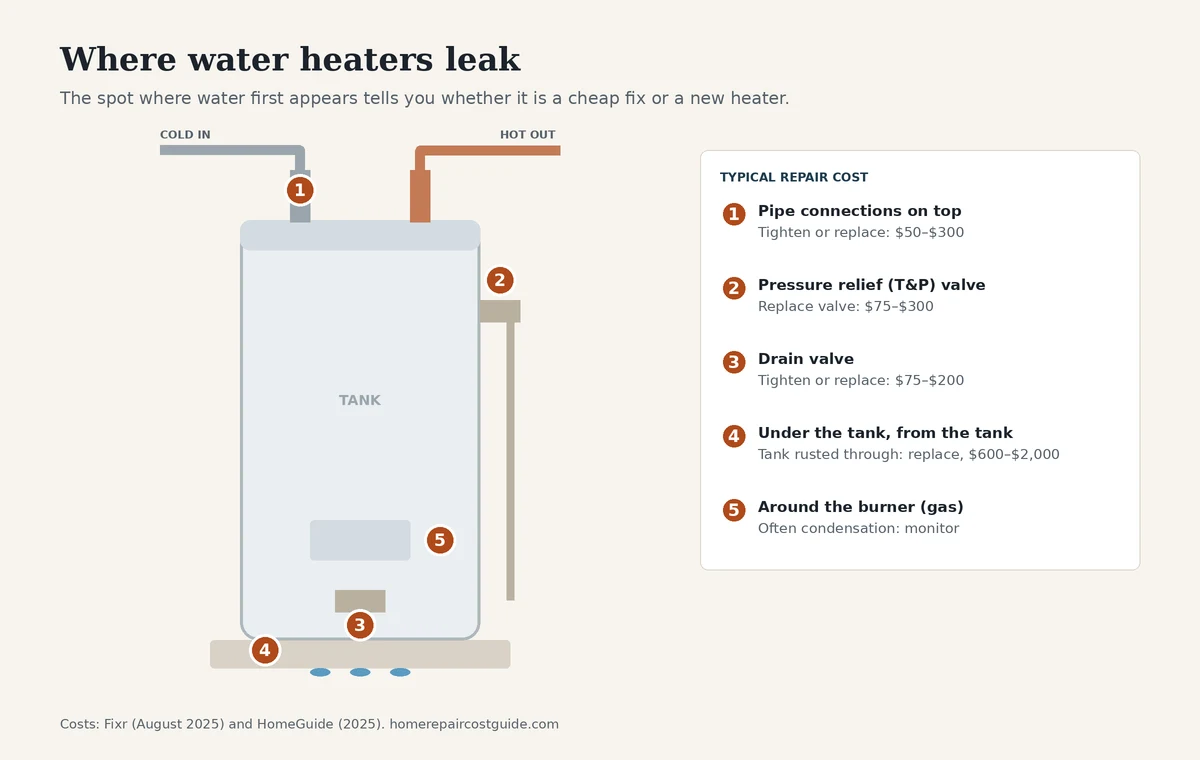
| Where it leaks | Likely cause | Usual fix | Typical cost |
|---|---|---|---|
| Top: pipe connections | Loose fitting or corroded connector | Tighten or replace the connector | $50–$300 |
| Side: pressure relief (T&P) valve or its pipe | High pressure or temperature, or a faulty valve | Replace the valve; check pressure and thermostat | $75–$300 |
| Bottom: drain valve | Valve not fully closed, or a worn valve | Tighten or replace the valve | $75–$200 |
| Bottom: under the tank, from the tank itself | Tank corroded through | Replace the water heater | $600–$2,000 |
| Around the burner (gas) | Often condensation, not a leak | Monitor; call if it continues | Often $0 |
A dripping T&P valve deserves attention: it opens when pressure or temperature inside the tank is too high. Replacing the valve is cheap, but a plumber should also check the water pressure and the thermostat setting so the new valve doesn’t start dripping too.
Water heater repair costs by part
| Repair | Typical cost (installed) |
|---|---|
| T&P (pressure relief) valve replacement | $100–$300 |
| Drain valve replacement | $100–$200 |
| Thermostat | $100–$350 |
| Heating element (electric) | $100–$750 |
| Anode rod | $125–$350 |
| Gas control valve | $150–$550 |
| Thermocouple (gas) | $100–$325 |
| Dip tube | $100–$300 |
Leak-point prices sit within the typical $50–$600 range for water heater leak repairs. Ranges combine two cost guides and vary with your area and the heater model. Expect an extra $100–$200 for night, weekend or holiday emergency visits.
Repair or replace?
A leaking tank cannot be repaired. Once the steel has rusted through, patching it isn’t safe or lasting. For other problems, these rules of thumb help:
- Age. Tank heaters usually last about 8 to 15 years. If yours is over 10 years old and needs a major repair, replacement is often the better buy. The manufacture date is usually printed on the label or encoded in the serial number.
- Cost. If the repair quote is around half the price of a new heater, or $1,000 or more, get a replacement quote too.
- Warning signs. Rusty hot water, rumbling noises from sediment, and hot water running out faster than before all point to a tank near the end of its life.
See what a new unit costs in our guide to water heater replacement cost.
Can you fix it yourself?
Tightening a loose drain valve or a pipe fitting with a wrench is a reasonable DIY job once the power and water are off. Replacing the T&P valve, gas parts or the heater itself is best left to a licensed plumber: these are safety devices, and many areas require a permit to replace a water heater.
Water damage from the leak
A slow drip can soak a subfloor or the bottom of drywall before you notice it. After a leak:
- Dry the area within 24 to 48 hours with fans and a dehumidifier to stop mold from starting.
- Pull back carpet and padding if they got wet, and check the bottom of nearby walls.
- If water reached a finished basement, read basement flooding: what to do.
Does homeowners insurance cover a leaking water heater?
Insurance usually treats the heater and the damage it causes differently:
- The water heater itself: generally not covered when it fails from age, wear or corrosion, which is why most tanks leak.
- Water damage to your home: often covered when the leak was sudden and accidental, such as a tank that bursts and floods the room. Damage from a slow leak that went on for weeks is usually denied as neglect.
- Equipment breakdown coverage: some insurers sell this as an add-on. It can pay to repair or replace appliances like water heaters after a mechanical failure.
For the full picture, read does homeowners insurance cover water damage.
How to prevent the next leak
- Flush the tank once a year to clear sediment.
- Have the anode rod checked every few years and replace it when it’s worn. It’s what stops the tank from rusting.
- Test the T&P valve once a year by lifting its lever briefly (stand clear of the discharge pipe).
- Install a drain pan and an inexpensive water leak alarm next to the heater.
- Keep the thermostat at about 120°F, which is safer and easier on the tank.
FAQ
Is a leaking water heater dangerous?
It can be. The water can scald, a leak near electrical parts is a shock risk, and a gas heater sitting in water can be damaged. Turn off the power or gas and the cold water supply first, then deal with the leak.
Can I still use my water heater if it is leaking?
If the leak is from a loose fitting or valve, you may be able to use it after it’s tightened or replaced. If the tank itself is leaking, stop using it and plan to replace it soon, because tank leaks only get worse.
Why is my water heater leaking from the bottom?
It’s either the drain valve, which is cheap to fix, or the tank itself has rusted through, which means replacement. Dry the area and check whether water comes from the valve or from under the tank.
How long does a water heater last?
Most tank water heaters last about 8 to 15 years, and tankless units about 10 to 20 years, depending on water quality and maintenance.