
Last updated: October 2026 · Cost data from the sources listed at the end
Most foundation cracks are cosmetic and cost $250 to $800 to seal with an epoxy or polyurethane injection. Cracks that point to structural movement are a different story: reinforcing a bowing wall or stabilizing a sinking corner typically runs $1,000 to $12,000+, and major underpinning can pass $30,000. The shape, width and behavior of the crack tell you which group you are in.
In this guide
- Is your foundation crack serious?
- How to tell if a crack is still moving
- Foundation crack repair cost by method
- What else affects the price
- Can you repair a foundation crack yourself?
- What causes foundation cracks?
- Does homeowners insurance cover foundation cracks?
- How to prevent new cracks
- How to hire a foundation repair company
- FAQ
Prices are per crack for injections. Structural repairs depend on the number of anchors, piers or straps needed. An engineer’s report adds $500–$1,000 or more.
Is your foundation crack serious?
Almost every house gets some cracks as concrete cures and the ground settles. What matters is the direction, the width and whether the crack is getting bigger.
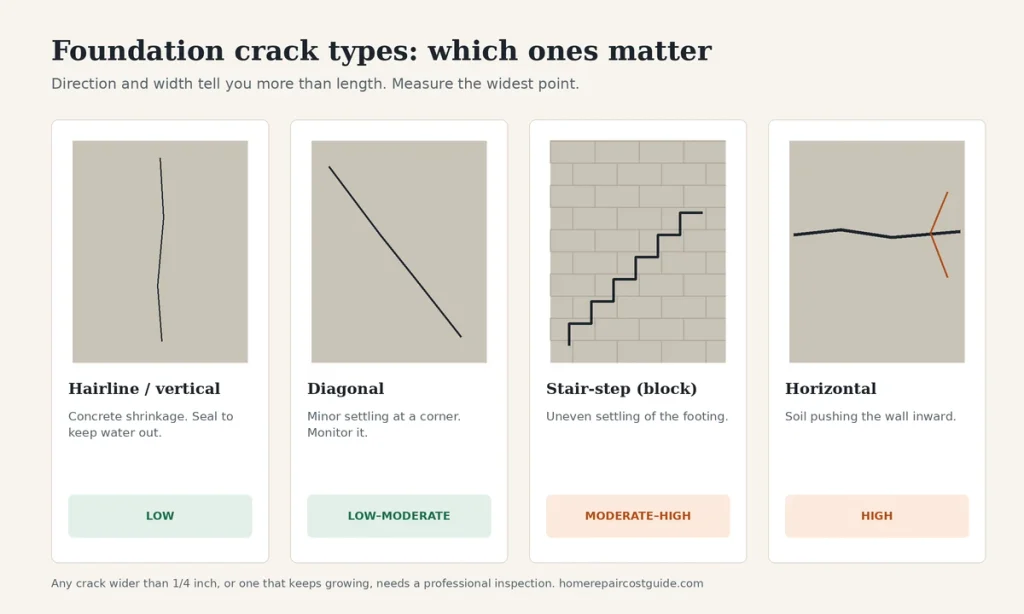
| Crack type | What it usually means | Concern level |
|---|---|---|
| Hairline or thin vertical (under 1/8″) | Normal shrinkage as concrete cures | Low: seal it to keep water out |
| Diagonal, thin | Minor settling at one corner | Low to moderate: monitor |
| Stair-step in block or brick | Uneven settling of the footing | Moderate to high |
| Horizontal | Soil pushing the wall inward | High: get an inspection |
| Any crack wider than 1/4″ | Active movement | High |
- A basement wall has a horizontal crack, or the wall is visibly bowing inward.
- A crack is wider than about 1/4 inch, or one side of it sits higher than the other.
- Doors and windows upstairs have started to stick, or new cracks appear in drywall above door frames.
- The crack is growing over weeks or months.
For a full checklist of warning signs inside and outside the house, see signs of foundation problems. If you have a horizontal crack, read horizontal crack in basement wall before you call anyone.
How to tell if a crack is still moving
Before you pay for structural work, it is worth knowing whether the crack is active. A simple test:
- Draw a pencil line across each end of the crack and write the date next to it.
- Measure the width at its widest point with a ruler or a crack gauge and take a dated photo.
- Check again every month for a few months, especially after heavy rain or a dry spell.
- If the crack grows past your pencil marks or gets wider, it is active and needs a professional opinion.
Foundation crack repair cost by method
The repair method depends on whether you only need to seal the crack against water or stop the wall from moving.
| Repair method | What it fixes | Typical cost |
|---|---|---|
| Epoxy or polyurethane injection | Seals non-structural cracks against water | $250–$800 per crack |
| Carbon fiber straps | Stops a cracked or slightly bowing wall from moving further | $900–$2,000+ per crack |
| Wall anchors | Pulls back or holds a bowing basement wall | $500–$1,000 each |
| Helical tiebacks | Braces walls from the outside into stable soil | $1,000–$3,000 each |
| Piers (push or helical) | Lifts and supports a sinking footing | $1,000–$4,000 each |
| Slab-jacking (mudjacking) | Raises a sunken concrete slab | $550–$1,300 |
| Underpinning, major | Deepens or strengthens the whole foundation | $10,000–$30,000+ |
Epoxy vs polyurethane: epoxy bonds the two sides of a crack and restores some strength, so it is used for dry cracks that need to be glued shut. Polyurethane foam expands and stays flexible, which makes it better for stopping water through cracks that may still move slightly. A good contractor will tell you which one your crack needs.
What else affects the price
- Number and length of cracks. Injection is priced per crack, so several cracks add up quickly.
- Access. Finished basements may need drywall, paneling or flooring removed and replaced.
- Inside or outside repair. Excavating outside the wall costs far more than working from the basement.
- Engineer and inspection. A structural engineer’s report usually costs $500 to $1,000 (up to $3,000 for complex homes). Repair companies often inspect for free, but they also sell the fix.
- Permits. From about $75 for minor work to $1,000+ for major structural repairs.
- Soil and drainage. If the cause is poor drainage or expansive clay, fixing gutters and grading is part of the job.
For anything structural, consider paying a licensed structural engineer before you sign with a repair company. The engineer has nothing to sell you, and the report tells contractors exactly what to quote, which makes quotes easier to compare.
Can you repair a foundation crack yourself?
A thin, dry, vertical crack in a poured concrete wall (no wider than about 1/8 inch) can be sealed with a DIY epoxy or polyurethane injection kit from a home improvement store. Follow the kit’s instructions closely and clean the crack well first.
Leave it to a professional if the crack is horizontal, stair-stepped, wider than 1/4 inch, leaking actively, or if the wall is bowing. Sealing the surface of a structural crack hides the symptom while the wall keeps moving.
What causes foundation cracks?
- Concrete shrinkage as it cures in the first year or two. These cracks are thin and usually vertical.
- Water and poor drainage. Clogged gutters, short downspouts and soil sloping toward the house soak the ground next to the walls.
- Expansive clay soil that swells when wet and shrinks when dry, pushing and pulling on the foundation.
- Frost and hydrostatic pressure pushing on basement walls from outside.
- Settlement of poorly compacted fill under part of the footing.
- Tree roots drying out the soil close to the house.
Does homeowners insurance cover foundation cracks?
Usually not. Standard policies exclude settling, shifting soil, gradual wear, slow leaks and poor construction, which are the causes behind most foundation cracks. Earthquakes and floods are also excluded unless you have separate coverage.
Damage can be covered when a sudden, covered event causes it, such as a burst pipe that floods the soil under the house, an explosion or a vehicle hitting the wall. If you think that is your situation, document the damage and get a structural engineer to state the cause in writing before you file. Read more in does homeowners insurance cover water damage.
How to prevent new cracks
- Keep gutters clean and extend downspouts at least 4 to 6 feet from the house.
- Make sure the soil slopes away from the foundation.
- Keep a sump pump in working order if you have one, and test it before the rainy season.
- Water the soil around the foundation during long droughts if you live on expansive clay.
- Plant large trees well away from the house.
How to hire a foundation repair company
- Get at least three quotes, and ask each company to explain the cause, not just the fix.
- Ask whether the warranty is transferable to a future buyer. Many companies offer long or lifetime warranties on piers and anchors.
- Check licensing, insurance and reviews, and ask for addresses of similar jobs.
- Be wary of high-pressure “today only” pricing, or a plan for many piers when only one wall shows movement.
For whole-house numbers, see our guide to foundation repair costs.
FAQ
How much does it cost to fix a crack in a foundation?
Sealing a single non-structural crack with epoxy or polyurethane typically costs $250 to $800. Structural repairs with straps, anchors or piers usually start around $1,000 and can exceed $10,000.
Are vertical foundation cracks normal?
Thin vertical cracks are very common and usually come from concrete shrinking as it cures. They are rarely structural, but sealing them keeps water out of the basement.
How long does foundation crack repair last?
A properly done injection should last for decades. Most reputable contractors back injections with a warranty against leaks, and structural systems like piers often carry a lifetime warranty.
Should I buy a house with foundation cracks?
Hairline and thin vertical cracks are normal. Horizontal or wide cracks deserve a structural engineer’s inspection before you buy, and the repair cost can be part of your negotiation.