
Last updated: October 2026 · Coverage information from the sources listed at the end
Homeowners insurance usually does cover water damage that is sudden and accidental and starts inside your home, like a pipe that bursts or a water heater that fails. It usually does not cover flooding, slow leaks that went on for weeks, sewer backups (unless you added coverage) or damage caused by wear and poor maintenance. The cause of the water is what decides the claim.
In this guide
Water damage and freezing are among the most common homeowners claims: roughly one in 60 insured homes files one each year (Insurance Information Institute).
What homeowners insurance usually covers
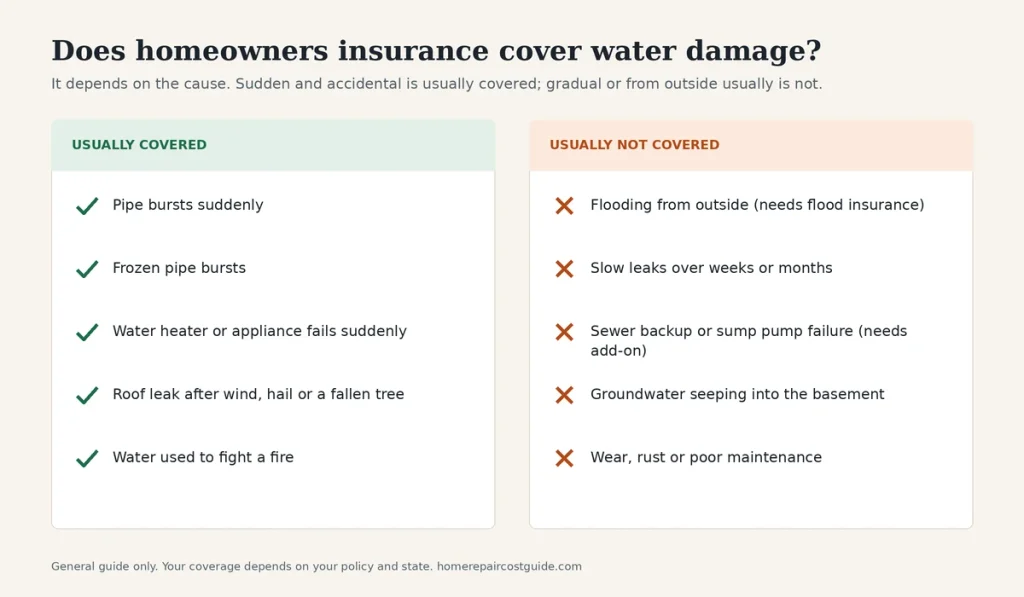
| Situation | Usually covered? | Notes |
|---|---|---|
| Pipe bursts suddenly | Yes | The water damage is covered; repairing the pipe itself often isn’t |
| Frozen pipe bursts | Yes, usually | Insurers may deny it if the home was left unheated without precautions |
| Water heater, washer or dishwasher fails suddenly | Yes | The appliance itself usually isn’t covered |
| Roof leaks after wind, hail or a fallen tree | Yes | Leaks from an old or worn roof usually aren’t |
| Water used to put out a fire | Yes | |
| Rain getting in through storm damage | Often | When wind or hail created the opening |
When the cause is covered, dwelling coverage pays to repair floors, walls, ceilings and cabinets, and personal property coverage pays for damaged belongings, minus your deductible. If the home is unlivable during repairs, loss of use coverage can pay for a hotel or rental.
What homeowners insurance usually does not cover
| Situation | Why it’s excluded | Where to get coverage |
|---|---|---|
| Flooding (rising water, storm surge, overflowing rivers) | Excluded from standard policies | Separate flood insurance |
| Slow, gradual leaks | Treated as a maintenance issue | Fix leaks early |
| Sewer or drain backup, sump pump failure | Excluded unless added | Water backup endorsement |
| Groundwater seeping into the basement | Considered gradual or flood-related | Waterproofing; flood policy |
| Damage from wear, rust or neglect | Not sudden or accidental | Regular maintenance |
| Mold from long-term moisture | Gradual damage; often capped | Mold endorsement (some insurers) |
Many denied claims come down to timing. A pipe that bursts and floods a room overnight is sudden. A drip under a sink that slowly rots the cabinet over months is gradual, and most policies exclude it. Check under sinks, around toilets and near the water heater regularly, and fix small leaks right away.
Flood damage needs a separate policy
Standard homeowners policies exclude flooding: water that rises from outside, such as heavy rain that the ground can’t absorb, overflowing rivers or hurricane storm surge. Flood coverage is sold separately, mainly through FEMA’s National Flood Insurance Program (NFIP) and some private insurers.
- NFIP policies cover up to $250,000 for the building and $100,000 for contents on a home.
- New NFIP policies usually have a 30-day waiting period before coverage starts, so you can’t wait until a storm is forecast.
- Flooding can happen outside high-risk zones too. Check your flood risk before deciding to skip it.
Add-ons worth knowing about
- Water backup endorsement: covers damage when sewers or drains back up or a sump pump fails. It is often inexpensive (some insurers charge as little as about $30 a year), with limits commonly around $5,000 to $10,000. If you have a finished basement or a sump pump, it’s worth asking about.
- Equipment breakdown coverage: pays to repair or replace appliances and systems that break down, like a water heater, which standard policies don’t cover.
- Service line coverage: some insurers offer it for underground water and sewer lines on your property.
- Mold coverage: raises the low mold limit many policies have.
How to file a water damage claim
- Stop the water. Shut off the main water valve or the supply to the appliance, and turn off electricity to wet areas if it’s safe.
- Document everything with photos and video before you clean up: the source, the damage and damaged belongings.
- Prevent further damage. Start drying right away. The EPA says water-damaged areas should be dried within 24 to 48 hours to prevent mold. Keep receipts for fans, dehumidifiers and emergency services.
- Call your insurer promptly and write down the claim number and the name of everyone you speak to.
- Keep damaged items until the adjuster has seen them, or photograph them carefully if they must go.
- Get repair estimates and compare them with the adjuster’s figures.
Should you file a claim for small water damage?
Not always. If the repair costs only a little more than your deductible, paying yourself may be cheaper in the long run, because claims are recorded in an industry database and can affect your future premiums. A rough approach:
- Get a repair estimate first.
- Subtract your deductible to see what the insurer would actually pay.
- Ask your agent how a claim could affect your premium.
- For large or uncertain damage, such as water inside walls or under floors, report it: hidden damage often costs more than it looks.
What water damage costs to repair
The average homeowners claim for water damage and freezing was about $15,400 between 2019 and 2023, according to the Insurance Information Institute. Your costs depend on the source and how quickly you act. See our guides to specific problems:
FAQ
Does homeowners insurance cover a burst pipe?
Usually yes. The water damage from a sudden burst is typically covered, minus your deductible. The cost of repairing the pipe itself often isn’t, and damage from a slow leak may be denied.
Does homeowners insurance cover a leaking roof?
It does when a covered event, such as wind, hail or a fallen tree, caused the leak. Leaks from an old or poorly maintained roof are usually not covered.
Is flood damage covered by homeowners insurance?
No. Flooding from rising or surface water requires a separate flood insurance policy, such as one from the National Flood Insurance Program.
Does insurance cover water damage from a sump pump failure?
Not under a standard policy. You need a water backup endorsement, which covers sewer and drain backups and sump pump failures up to a set limit.
Sources
- Insurance Information Institute – Facts + Statistics: Homeowners and renters insurance
- NerdWallet – Does homeowners insurance cover water damage? (updated June 2026)
- FEMA – National Flood Insurance Program coverage
- Hippo – Water backup coverage
- U.S. EPA – A Brief Guide to Mold, Moisture and Your Home