
Last updated: October 2026 · Cost data from the sources listed at the end
Crawl space encapsulation typically costs $3,000 to $15,000, or about $3 to $10 per square foot. A basic job with a heavy vapor barrier and sealed vents can come in at $2 to $4 per square foot; spaces that need cleaning, mold removal, drainage or a dehumidifier land at the top of the range. Here is what goes into the price, and how to tell whether you need the full system.
In this guide
- What crawl space encapsulation includes
- Crawl space encapsulation cost by size
- Vapor barrier thickness and price
- What else affects the price
- Encapsulation vs a vapor barrier only
- Is crawl space encapsulation worth it?
- Can you encapsulate a crawl space yourself?
- Does homeowners insurance cover encapsulation?
- How to choose a contractor
- FAQ
National average: about $5,500 (HomeAdvisor, 2026). Labor is usually 50%–70% of the total.
What crawl space encapsulation includes
Encapsulation turns a damp, vented crawl space into a sealed, dry one. A complete job usually combines several of these steps:
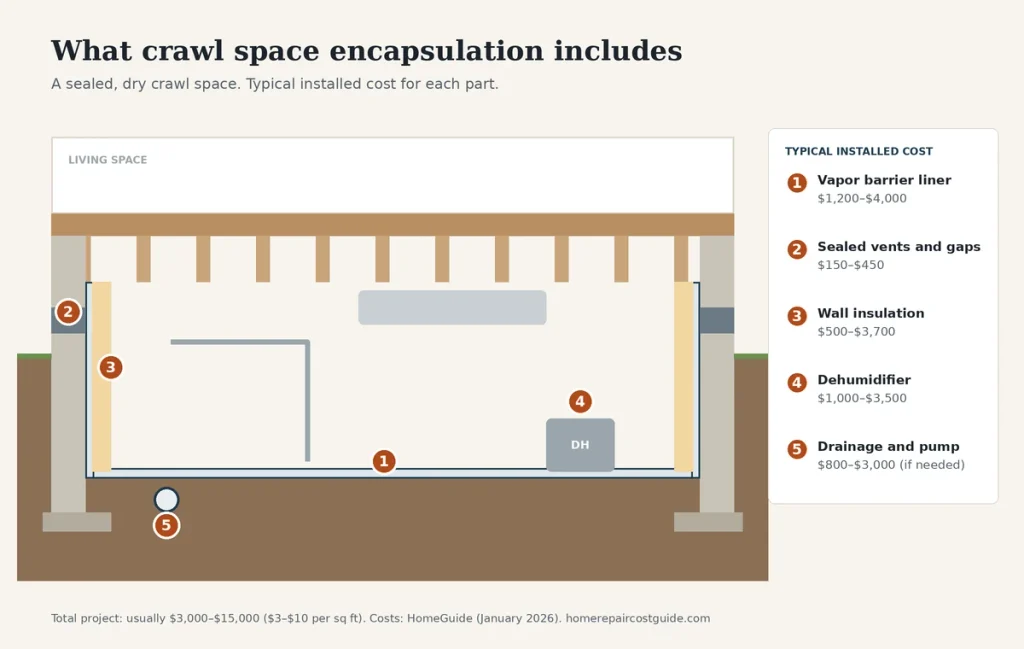
| Component | What it does | Typical cost |
|---|---|---|
| Inspection | Checks moisture, mold, pests and structure | $100–$300 |
| Cleaning and debris removal | Clears the space before sealing | $500–$8,000 |
| Vapor barrier (installed) | Heavy plastic liner over the ground and up the walls | $1,200–$4,000 |
| Sealing vents and gaps | Stops humid outdoor air getting in | $150–$450 |
| Wall or subfloor insulation | Keeps the space and the floors above warmer | $500–$3,700 |
| Dehumidifier (installed) | Holds humidity at a safe level | $1,000–$3,500 |
| Drainage system with pump | Removes water that gets in after rain | $800–$3,000 |
| Mold remediation (if needed) | Removes existing mold before sealing | $1,500–$4,000 |
| Permits (where required) | $50–$250 |
Crawl space encapsulation cost by size
| Crawl space size | Typical installed cost |
|---|---|
| 1,000 sq ft | $3,000–$10,000 |
| 1,500 sq ft | $4,500–$15,000 |
| 2,000 sq ft | $6,000–$20,000 |
| 2,500 sq ft | $7,500–$25,000 |
| 3,000 sq ft | $9,000–$30,000 |
The low end of each range assumes a clean, dry space that only needs a liner and sealed vents. The high end includes cleaning, insulation, a dehumidifier and drainage.
Vapor barrier thickness and price
Vapor barriers are sold by thickness in mils (thousandths of an inch). Thicker liners cost more but resist tearing when people crawl over them for repairs.
| Thickness | Material only, per sq ft | Best for |
|---|---|---|
| 6 mil | $0.30–$0.35 | Basic ground cover; tears easily |
| 10 mil | $0.40–$0.50 | Light encapsulation |
| 12 mil | $0.50–$0.60 | Common choice for full encapsulation |
| 20 mil | $0.60–$0.70 | Heavy traffic, best durability |
Installed, a vapor barrier usually runs about $2 to $4 per square foot including labor, sealing seams and fastening it to the walls and piers.
What else affects the price
- Condition of the space: standing water, debris, old insulation or pests all have to be dealt with first.
- Height and access: very low crawl spaces take longer to work in.
- Climate: humid regions are more likely to need a dehumidifier and drainage.
- Foundation problems: cracks or sagging joists should be fixed before sealing.
- Local labor rates, which make up about 50% to 70% of the bill.
Encapsulation vs a vapor barrier only
| Vapor barrier only | Full encapsulation | |
|---|---|---|
| What it covers | The ground | Ground, walls, piers, vents and air sealing |
| Vents | Left open | Sealed |
| Humidity control | None | Dehumidifier or conditioned air |
| Typical cost | About $2–$4 per sq ft installed | $3–$10 per sq ft |
| Good for | Dry climates, mild moisture | Humid climates, mold, musty smells, wet ground |
Is crawl space encapsulation worth it?
It is usually worth it if you have mold, a musty smell in the house, standing water, wet insulation or cupping wood floors, and you live in a humid area. It removes the cause rather than treating the symptoms over and over. See mold in crawl space for the warning signs.
It is often not needed in dry climates when the crawl space stays dry year-round. A good-quality vapor barrier and well-managed gutters may be enough.
Sellers often promise large energy savings and a quick payback. A drier crawl space can make floors warmer and help your HVAC run more efficiently, but savings depend heavily on your climate, your ductwork and your home. Ask for any savings estimate in writing and treat it as a bonus, not the reason to buy.
Can you encapsulate a crawl space yourself?
Laying a vapor barrier in a dry, accessible crawl space is a doable DIY project. Materials for 1,000 sq ft of 12-mil liner cost roughly $500 to $600, plus tape and fasteners. Leave it to a contractor if there is standing water, mold, damaged wood, or if the plan includes sealing vents near gas appliances, sump pumps or dehumidifiers that need wiring and drainage.
If a gas furnace or water heater sits in the crawl space, sealing the vents can affect the air it needs to burn safely. Have a licensed HVAC contractor check combustion air before you seal anything.
Does homeowners insurance cover encapsulation?
No. Encapsulation is considered a home improvement or maintenance, so insurers don’t pay for it. If a sudden covered event, such as a burst pipe, damaged the crawl space, the cleanup and repairs to the damage may be covered, but not the upgrade to an encapsulated space. See does homeowners insurance cover water damage.
How to choose a contractor
- Get at least three quotes that list the liner thickness, how seams and walls are sealed, the dehumidifier model and the warranty.
- Ask how they will handle existing mold and the cause of the moisture.
- Check that the quote includes sealing vents and access doors, not just the ground cover.
- Be wary of quotes far above the others without a clear reason, and of pressure to sign the same day.
FAQ
How much does it cost to encapsulate a 1,500 sq ft crawl space?
Typically $4,500 to $15,000. The low end covers a liner and sealed vents in a clean, dry space; the high end includes cleaning, insulation, a dehumidifier and drainage.
How long does crawl space encapsulation last?
A heavy, well-installed liner can last for many years, and many contractors offer long warranties on the liner. Dehumidifiers and pumps are mechanical and will need replacing over time.
Do I need a dehumidifier after encapsulation?
In humid climates, usually yes. Sealing the space keeps outside air out, but something has to remove the moisture already there and the moisture that still gets in.
Does encapsulation increase home value?
It can make a home easier to sell, since buyers and inspectors look for moisture problems under the house. Any increase in value depends on your local market.